|

|
The
History of World War I
through sheet music
By Bruce Updegrove
Edited By Eleanor Jenitis
|
|
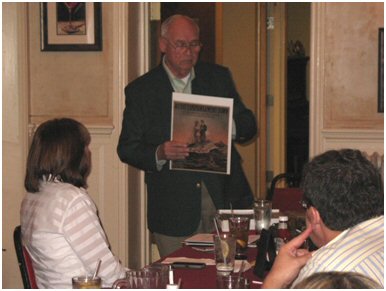 Bruce
used to teach 11th grade American history and embraced the
challenge of trying to bring his students into the history
of America and raise their awareness as to who we are. Bruce
used to teach 11th grade American history and embraced the
challenge of trying to bring his students into the history
of America and raise their awareness as to who we are.
Bruce
amazingly and cleverly walked us through the war vis-a-vis
the sheet music covers and titles, a fascinating walk. While
the war was from 1914-1918, the United States becomes fully
involved in 1917. Bruce pointed out that during the war there
wasn't really that much to do at home, and thus many people
tried to learn to play an instrument, with piano always being
a favorite. So the people depended upon sheet music to keep
the entertainment going. Sheet music, its covers and titles,
became a reflection of American sentiment on the war.
"I
Didn't Raise my Boy to be a Soldier," depicted an Oriental
woman on the cover, likely a visiting piano instructor. Bruce
added that the woman could actually have paid the publisher
for the advertisement. But the title clearly indicates that
not everyone was supportive of the war in its nascent stage.
Then
we have the sinking of the Lusitania. '"Now's the Time
to Wake up America" appears on a cover. We start to see
more patriotic music emerging, as in "Answer Mr. Wilson's
Call" and "Let Us (America) Make the World Safe
for Democracy." This being a little tricky, as we were
fighting Germany and aligning with Czarist Russia, living
in a feudal system, though for a brief time in 1917, Russia
had something resembling a democracy, though it ended in November
1917.
America answers the call to war and we see "America,
Here's my Boy" and "Let's All be Americans"
sheet music. We see more patriotic songs, as with "You
Can't Beat Us" depicting Uncle Sam pointing at viewer.
We see realization of the reality of war, as with "Take
Good Care of Mother When I'm Gone." Also, "K-K-K
Katy" is about a young soldier who loves a girl but stutters
when he tries to tell her. Bruce told us a story about a time
he went to a rest home in the 1970s to discuss the various
songs, and when this one came up, a woman residing at the
rest home sang it to the hilt, along with other songs of the
WWI era!!
Songs like "Hitting the trail to Normandy," "They
Were All Our of Step but Jim," "Oh, How I Hate to
Get Up in the Morning," by Irving Berlin (the most noted
lyricist in WWI) all reflect the soldier's musings during
the War.
 As
a side note, Irving Berlin wrote a song called "God Bless
America" in 1918 while he was a soldier serving the U.S
Army at Camp Upton in Yaphank, New York, but decided it did
not fit in a revue called "Yip Yip Yaphank," so
he set it aside. Then, in 1938, Kate Smith sang a very patriotic
song on an Armistice Day broadcast on her radio show. Whether
it was the ominous rise of Hitler driving Irving Berlin to
resurrect his song from WWI or whether Kate Smith contacted
him to see what patriotic songs he might have in his repertoire,
we probably won't know for certain. Either way, Kate Smith
was the first to sing the re-written "God Bless America"
and she immortalized the song forever! As
a side note, Irving Berlin wrote a song called "God Bless
America" in 1918 while he was a soldier serving the U.S
Army at Camp Upton in Yaphank, New York, but decided it did
not fit in a revue called "Yip Yip Yaphank," so
he set it aside. Then, in 1938, Kate Smith sang a very patriotic
song on an Armistice Day broadcast on her radio show. Whether
it was the ominous rise of Hitler driving Irving Berlin to
resurrect his song from WWI or whether Kate Smith contacted
him to see what patriotic songs he might have in his repertoire,
we probably won't know for certain. Either way, Kate Smith
was the first to sing the re-written "God Bless America"
and she immortalized the song forever!
Bruce reminded us that the sheet music really was quite elaborate,
in three color, almost like posters. This was evident as he
held up sheet music after sheet music. Absolutely beautiful
illustrations. Bruce then went on to highlight myriad songs
which again, reflected the hearts, souls and minds of Americans
during the war, from whimsical, to proud, to hopeful, to sad,
to glad:
"I Don't Know Where I'm Going, But I'm on my Way"
(Bruce jokingly noted it should be a senior commencement song!);
"We're Coming Uncle Sammy;" "Goodbye Broadway,
Hello France;" "Just Like Washington Crossed the
Delaware, Pershing Will Cross the Rhine;" "Over
There!" (by George M. Cohan); "Pack Up Your Troubles
in Your Old Kit Bag and Smile, Smile, Smile;" "There's
a Little Blue Star in the Window;" When The Little Blue
Start in the Window Has Turned to Gold" (Bruce reminded
us that a blue star hanging in the window signified that a
family member was serving in the military; a gold star meant
the family member was killed in the war.); "Germany You'll
Soon Be No Man's Land;" "When the Yankees Yank the
Kaiser Off His Throne;" "There's an Angel Missing
from Heaven;" "If I'm Not at the Roll-Call (Kiss
Mother Good-bye for Me);" "Bring Back My Daddy to
Me;" "Hunting the Hun."
And finally, as the war ended, "They're Coming Back;"
"Mother Here's Your Boy;" "You'd Better Be
Nice to Them Now" (meaning the women in a post-war economy).
Bruce concluded with the thought that the sheet music continued
to reflect the National sentiment even after the War. In 1918
it references Prohibition with "What'll We Do On a Saturday
Night When the Town Goes Dry." Sheet music also followed
the women's right to vote in 1920.
Bruce was asked how and where he acquired such a remarkable
collection of sheet music. Mainly flea markets over the past
20 years.
Thank you, Bruce, for illustrating the war through sheet music!
|
|
The
Top Antiques of 2014
By Arthur Schwerdt
|
 |
|
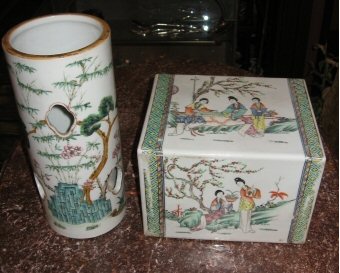
Old
Chinese export porcelains are very popular now, but
collectors want them to be very old and very special,
like this hat stand (about $650) & meditation pillow
(about $1,200).
|
There
is no question that the antique business
is not the frenzy it was ten or fifteen years ago, but, in
general, it's doing just fine. Just look at
the number of shows on television having to do with antique
and vintage items. People are still
very interested.
Here's my annual list of what kinds of things
people seem to be interested in today. I put it together based
on what I have seen around in my travels and read about in
the trade publications
and on the Internet. There is so much more out there than
is listed here; all you have to do is get out to the shops
and look around. It's fun.
Some items get more attention on the antiques market for obvious
reasons. For instance, since
it's the Year of the Horse in the Chinese calendar; so,
why not take another look at all the horse-related art, collectibles
and decorative accessories out there?
Horses are beautiful animals that have always inspired collectors
and decorators, but a year like this can make converts. Some
folks over the next few months will decide that decorative
accessories featuring horses are just what their interior
design needs - an oil painting, a sporting print, a bronze
figure, clock, or lamp. Or maybe it will be some mounted racing
or riding memorabilia.
Inviting a different kind of collector, this summer we commemorate
the 100th anniversary of the First World War. History buffs
and military collectors will pour over battle strategies,
battlefront memorabilia uniforms, armaments and gear, medals,
maps, munitions boxes, etc. On the softer side, there are
the sentimental postcards and handmade handkerchiefs sent
back by American soldiers in Paris. There are also home front
posters and sheet music.
All kinds of American military memorabilia has been vigorously
collected lately. The Civil War still leads the field, but
this year we'll be giving special attention to this "war
to end all wars."
Old American patriotic art and symbols are gaining interest
on the current market. The older the better in this field,
but you can come right up to the Bicentennial in 1976. This
would include paintings or prints of American presidents,
statesmen, military figures, historic moments, landmark buildings,
busts, flags, eagles, images of Uncle Sam, editorial cartoons
and political memorabilia.
These days some Chinese exports may be disparaged for shoddy
workmanship or questionable contents materials. There was
a time, however, Chinese export porcelains were considered
among the most prized possessions in any household. They deserve
every bit of that reputation. The quality of the porcelain
and the decoration are so exquisite they seem almost calculated
to impress us. Today, it's often the Chinese, themselves,
that seem the most impressed by their ancestors' skill, and
that has given a boost to this market.
A segment of the population seems to be weary of traditional
English and French decorative options. That's given rise to
the popularity of painted furniture. This is really a revival
of Cottage Style Victorian. (And you thought Victorian was
over. It's never over).
It's surprising how well the painted furniture look can work
in even the most modern-style homes. It's easy, breezy, casual,
warm and homey. What's not to like?
Those who are looking for a more sophisticated environment
are still opting for the Mid-Century High Style (1940-1970),
either the traditional "Decorator" look, or post-war
Modern, where every chair, lamp and vase is a work of art.
Very smart.
This flashy 20th Century look is what is also "in"
in estate jewelry these days. Just look at the Cartier ads;
it's jewelry you want them to notice across the room. The
originals are in the antique shops, and they are also entirely
hand-crafted.
Don't overlook all the everyday utilitarian items folks are
finding in antique shops. These are things you might otherwise
shop for in the national chains and discount stores - mixing,
serving and salad bowls, mugs, refrigerator dished, skillets,
teapots, soap dishes, pot holders, table cloths and napkins,
spice jars, etc., etc.
Coming from an antique shop, these items are not only unique
and classy, they are often better made than what you can find
new.
Also riding high in the market these days are the following:
sewing items (a thimble just sold for $20,000), musical instruments,
tin litho toys, Victorian ABC plates (especially those with
mottoes), LPs (check the Internet), silver, advertising signs,
doll house furniture and miniatures, architectural and garden
items.
There are about 40 antique shops here on the Cape. You can
get a list from the Cape May County Department of Tourism
(465-6415 or, out of the area at 1-800-227-2297). You can
reach them on the Internet at www.thejerseycape.com.
Arthur Schwerdt, a certified appraiser, is the author of "The
Antique Story Book: Finding the Real Value of Old Things,"
and co-owner of The August Farmhouse Antiques on Route 9 in
Swainton. Send your comments, questions and appraisal requests
to aschwerdt@cmcherald.com.
|
|
19th
Century Photography - An Introduction
By Bob Lucas
Edited by Eleanor Jenitis
|
|
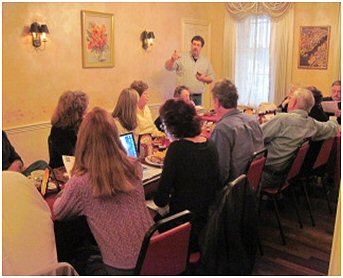 Bob
delivered a broad and informative presentation of the history
and technology of 19th century photography. Bob
delivered a broad and informative presentation of the history
and technology of 19th century photography.
Subject
matter included "Hard" Images (Daguerreotypes, Ambrotypes
and Tintypes - along with size descriptions) and "Soft"
Images (Calotypes, Salt Prints, Albumin Prints, Gelatin Prints).
Bob described various characteristics of each medium, along
with some commercial aspects.
Daguerreotypes,
1839-1860. Bob pointed out that the sensitivity of the
process and thus the time required to photograph a subject
for a daguerreotype was lengthy; photographers, therefore,
developed stationary assists against which the subjects could
lean or which held portions of the body firmly in place. Bob
also mentioned that the vapors from the process were not the
best for developers/photographers. The image produced was
one of a kind with no easy replication, thus restricting commercial
distribution viability.
From
a collectible standpoint, what is important is subject matter
and rarity. Condition is always a key driving factor, but
can be trumped by rarity. The case itself can also have value,
e.g., a full plate, empty, leatherette case, hinges relatively
okay, can fetch $200-$400. A daguerreotype of George Washington
can be a $2,000 - $3,000 range.
Ambrotypes,
1854-1864. Again, condition and subject are important.
Content, pleasant image, clarity, etc. drives desirability.
E.g., dogs usually more desirable than cats.
Tintypes,
1856-1940. Similar characteristics drive desirability.
These are fundamentally the last images that were placed into
cases.
Paper
Photography - The Civil War helped facilitate the technologies
because images were so easily duplicated. Soldiers from the
field and prior could distribute to family and friends. They
were easily mailed, and were inexpensive, e.g., twelve for
$1.00 (vs., e.g., one daguerreotype for $1.25).
Calotypes,
1841-1860. Tended to be fairly fuzzy, do not like exposure
to light, especially bright lights. In fact, image could,
would and does, quickly disappear!
Salt
Prints, 1852-1861. Characteristics similar to those of
calotypes.
Albumen
Prints, 1850-1910. This medium included the mighty CDV
(carte de visite) and represents so many of our Civil War
soldier and military images. With this technology, could print
as many as desired and thus enjoyed great commercial viability.
Gelatin
Prints, 1880-1910. These tend to be a lot darker, e.g.,
blue/brown, and do not have as much value.
Stereoviews.
Two images that were placed on a paper card (or glass slide)
were photographed at angles akin to the alignment of the human
eyes. A stereopticon (or stereo viewer) is used to view the
card and when properly placed and viewed, a 3D image materializes.
Fundamentally, the stereoview is the first 3D technology!
This
became a major force in the commercial world. People could
see images from around the world in 'vibrant' 3D. Keystone
Publishing Co. was a common publisher. Desirability factors
include city scenes, Americana, good tone, etc.
Those
with paper labels placed by hand on the back and filled in
with ink are probably earlier ones and may increase desirability/value.
(Printed backs are more common.) But again, overall, condition,
subject matter and its rarity are paramount.
While
speaking, Bob also distributed myriad examples of the photography
types and cases, which helped crystallize his discussion.
He also provided us with a nice list of research sources,
found in the attachment. To identify an image unknown to the
owner, Bob recommends "Dictionary of American Portraits."
Bob
concluded with a brief discussion on reproductions and forgeries.
Given that many CDV images, e.g., of famous Civil War generals
or political figures can be quite valuable, lots of ingenuity
exists to deceive with CDVs. Do business with reputable dealers,
and of course, always look for the dot prints on an image
(that indicates a modern machine reproduction). To increase
value and facilitate sale of a CDV albums, Bob indicated some
folks might be feathering an album with one or two good soldier
CDVs and filling the balance with very ordinary CDVs.
Beware
signatures found on the CDVs as well. Remember that the paper
was tight when new, but as it ages, tends to separate. If
ink is added later, it will likely bleed more than a little.
Bob
gave a delightful, informative and participative discussion.
|
|
Political
Pinbacks
By Tony Lee
Edited by Eleanor Jenitis
|
|
Tony
delivered a lively and varied presentation on political pinbacks,
laced with numerous examples which he distributed to the group.
Tony introduced himself as President of American Political
Items Collectors (APIC), "Big Apple" chapter, Titusville,
PA. Tony mentioned that their annual convention, this year
in Columbus, boasted 242 dealers and good attendance. He also
mentioned he is encouraged by the amount of younger people
entering this collecting arena.
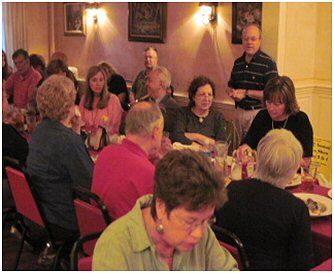 Tony
referenced Ebay and its part in this collecting field. Similar
to other categories of collecting, Ebay has provided access
to much more inventory (e.g., a quick search yields over 10,000
political items) and thus has also acted as a price equalizer.
He noted that as with other fields, quality always sells and
at good prices. Tony
referenced Ebay and its part in this collecting field. Similar
to other categories of collecting, Ebay has provided access
to much more inventory (e.g., a quick search yields over 10,000
political items) and thus has also acted as a price equalizer.
He noted that as with other fields, quality always sells and
at good prices.
Tony
recalled the genesis of his collecting of political items.
In the late 1960's, Tony's brother attended various protest
marches, where he gathered myriad buttons of the era. Tony
at one point brought the grouping into school, and lo and
behold, his teacher also had some and offered them to Tony.
Instant larger collection!
Tony
challenged our knowledge of history a bit, asking when and
what might have been the first political campaign item. Answer,
George Washington provided clothing buttons, given to be sewn
onto outer-wear in support of the new president.
As
a side note, Tony noted that in the movie "National Treasure,"
part of the secret for which they are searching were some
Washington Inaugural Buttons...
Celluloid
pinback buttons were introduced in 1896, during the McKinley
vs. Bryan campaign. These buttons were invented in Newark,
New Jersey, with the original building still standing. 1896-1916
is considered among collectors as the Golden Era of political
buttons, especially those of the 1 1/4" size. Artists
would create the design, place celluloid around it, then mass
produce. Though the quantities were far larger than ever before
produced, they were not massive, by today's standards.
Circa
1908, the manufacturing process changed. We move to lithography,
which is stamped onto the pinback. Not as pretty, but the
process enabled yet again, far greater manufacturing quantities.
This downwardly affects value, because those quantities are
still out there and available.
Tony
highlighted a rare piece and also tested our political savvy.
In 1920, the Republicans ran one Senator Warren Harding, former
newspaper man with Calvin Coolidge as VP. The Democrats responded
with Governor James Cox, newspaper publisher. Cox didn't have
much financial support, didn't spend his own money and even
with his running mate as Franklin Delano Roosevelt, the Democrats
lost in a landslide. Because the money tight or not wanted
to be spent, buttons are relatively scarce from this election.
Jugates (political buttons with two portraits side by side)
with both candidates have sold between $20K to a record high
of $130K. In the following election cycle, 1924, again, not
many political buttons were circulated. Incumbent Republican
president Calvin Coolidge ran against the Democratic ticket
of James Davis and VP Charles Bryan, Wm. Jennings Bryan's
son. Landslide victory for the Republican ticket. Since buttons
from this campaign are also relatively rare, they have value,
e.g., $5k - $45K, still behind a Cox jugate, but valuable.
Tony
also told us an anecdotal story of a gentleman who attended
a box lot auction, and after many "choice again"
calls, he purchased the balance of the box lots for $1.00,
in which he found a Cox jugate. Sold at Heritage. Always nice
to hear the discovery tales!
Tony
then moved us through traditional value and evolving value
items. Historical impact and scarcity of items traditionally
always draws. That said, lately, textiles have come into their
own. So-called entry-level hankies, bandanas, etc. used to
have low value, but now can run into the hundreds. Significant
campaign flags, banners with graphics, have sold between $10-$20K,
depending on their historical significance and rarity. Also
appreciated by collectors are beautiful posters, great graphics,
scenic backgrounds with campaign advertising, etc.
Ferrotypes,
tintypes with running mate on reverse, are desirable, but
as with most things, condition has become important; in fact,
it is paramount.
In
addition to the pinbacks, Tony also brought examples of tintypes,
gemshells and tokens. Tokens, because they so numerous and
because the customer base has waned, are not particularly
valuable; in fact, they have actually depreciated in general
value.
Tony
addressed the usual bane of collecting, reproductions. Reproductions
in political buttons were heavily produced in the late 1960s-1970s.
How to detect? Sometimes obvious and sometimes not. Obvious
course is to look at the rim of a button and read what's on
that rim. E.g., if it says, "Kleenex Tissues," this
was obviously a reproduced item for advertising purposes.
Also,
look at the rim for scratches or "scratch-outs."
Likely these are reproductions, with the scratches trying
to delete/hide the advertising.
Older
buttons should be celluloid, generally. Often buttons have
no date because the buttons were of the day, and all knew
the date. So, if a button has no date, it probably and may
be okay. That is not to say, however, that a button with a
date is a reproduction, though it certainly may be. This is
an area where one needs to know the types and traditions of
pinback button issuances of that time. It is best to consult
an expert.
Also,
if you have a celluloid button with an old newspaper backing
(made to look like it is of the period), it's a reproduction.
Buttons did not have current/local newspaper backing at that
time.
These
are a few hints to determining whether a button is right or
not, but sometimes it becomes difficult to tell. Best to consult
with an expert collector to verify what you might have or
discover...
Finally,
in closing and in a general question and answer exchange,
and therefore in no particular order, we learned a few more
salient points.
On
whether collectors should start collecting new buttons, Tony
indicated possibly (though he said so very cautiously), depending
on how many were made and how unique the campaign advertising.
E.g., if a new button at a local fair for a candidate where
quantities were limited, those might have a better shot at
some nearer-term future value. Or, e.g., buttons issued at
a particular closed-door fundraiser, where surely only a few
were issued, might see some value. But even with that, new
buttons don't have a great shot at near-term collecting value.
Tony reminded us that in the pre-Ebay era, people would get
new buttons, squirrel them away for a while, and then be able
to sell. Ebay changed that. Too many of everything is available
now.
Tony
mentioned that the notion of scarcity of quantity of a particular
aspect of a campaign can also be true with older buttons,
e.g., a Roosevelt with a 1944 Keystone State (PA) nudges the
value upward a tad, from ~ $10 to $25.
Political
buttons of people who have crossed over functional lives can
sometime be okay, e.g., Senator John Glenn, later becoming
Astronaut John Glenn.
In
general, campaign items are more collectible than standing
presidential items. E.g., Candidate Truman items, (Truman
not having as much financial support and therefore issuing
relatively less campaign paraphernalia), tend to be more valuable
than items issued later, as President Truman, when he had
more monetary support.
Campaign
advertising lanterns in mint condition are showing good value.
Tony
mentioned that the Allentown Paper Show (held three times/year
- April, July and October) is the best venue for selling,
buying, trading and observing great variety and quality.
A 1948 textile with all the presidents until Truman do not
have very much value because they were expressly made as collectibles.
Newspapers
with political content are just not worth anything. Yes, historical,
but still no value. Occasionally a "Dewey beats Truman"
newspaper can garner some money ($1-$2k), but generally, newspapers
are worthless.
Tony
Lee may be reached at 610-730-9490, on his cell at 609-802-1966
or at tony@adicio.com.
|
|
Antique
Marbles
By Chris Doerner
Edited by Eleanor Jenitis
|
|
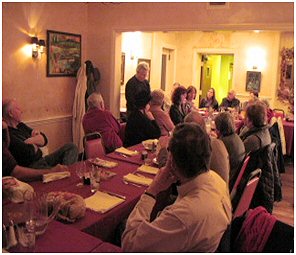 Chris
Doerner shared with us the antique marble collecting world.
Chris has a multi-faceted background, owning, with his wife,
21st Century Auctions. He also has been a producer and director,
involved in the independent movie world. Chris
Doerner shared with us the antique marble collecting world.
Chris has a multi-faceted background, owning, with his wife,
21st Century Auctions. He also has been a producer and director,
involved in the independent movie world.
Chris
opened his presentation with the jargon of antique marbles:
"If you're the type of mibster that has knuckled down
with a taw and shot for an aggie duck, then you already know
quite a bit about mibs."
The
jargon: mibster = a marble player; knuckle down = getting
ready to shoot marbles; taw, = shooter marble; aggie duck
= English slang for a type of marble; and mibs = marbles.
No
one can really ascertain when and where marbles were created.
They have been found in ashes of Pompeii, across the Roman
Empire and in the tombs of ancient Egypt. Native American
tribes have played with marbles. So, it's virtually impossible
to pin down a precise country of origin. Chris opined that
perhaps they originated with the cave men, who possibly gave
stones, polished smooth by a running river, to their children
to keep them busy!
Chris
led us to the next subject of discussion: Artisan-Made Marbles
- those shaped by hand from clay, stone or glass.
Hand-Made Glass Marbles:
- Grew
in popularity from the late 1800s;
- Were
individually planned, cut and finished the same way high
end blown glass vases, canes and whimsies were;
- Individual
glass rods - some quite tiny - were laid on an oiled metal
plate or anvil and a blob of molten glass was rolled over
the rods to produce particular patterns;
- A
glass cylinder was rolled out thinner and thinner until
it reached proper diameter. This was known as the "cane"
stage.
Some
of the glass canes today that don't have the traditional U-shaped
handle are, in reality, marbles canes that were never cut.
The glass blower snipped off the marble and dropped it into
a wooden mold. Glass would be rolled around with a wooden
paddle until most or all of the pontil disappeared. (A pontil
mark is the scar where the pontil was broken from a work of
blown glass. The presence of such a scar indicates that a
glass bottle or bowl was blown freehand, while the absence
of a pontil mark suggests either that the mark has been obliterated
or that the work was mold-blown. Also, in the collectibles
and antiques industry, the term pontil refers to the mark
impressed on a blown glass item over this scar, since many
notable glassblowers have impressed or engraved maker's marks
in the pontil scars of their work.)
The
glass would then be placed into an annealing oven to cool
for approximately 48 hours. It is for the following reason
that most marbles do not measure more than 3" in diameter:
Right around the 2 3/4" mark, the weight of the glass
during the annealing process causes the marble to sag on one
side, creating essentially a paperweight.
Only
the most skilled of marble makers could create the right lattice
of glass rods to support marbles of this size. While the most
beautiful of all types of marbles available, they were also
the most difficult to make, the most expensive to make, but
why today they are so desirable and valuable.
Clay
and Porcelain Style Marbles:
- Mass
production started around 1884;
- Sam
Dyke of Akron, Ohio, created a wooden block with six grooves,
each holding a lump of clay.
- An
operator would roll a wooden paddle over all the clay balls
at once, creating six marbles at a time;
- With
350 employees, Dyke's factory cranked out five train cars
worth of marbles every day. That equals about one million
marbles per day!!
- What
cost one penny each before, dropped to a bag of 30/cent;
- Dyke's
efforts made Akron the marble capital of 19th century America.
Glass Machine-Made Marbles:
In
1915, the mass production of glass marbles began. M.F. Christensen
designed a machine to produce thousands of glass marbles an
hour. His machine consisted of a screw conveyor made up of
two grooved cylinders spun next to each other. A "slug"
of molten glass was paced between the cylinders on one end
and it was gradually carried down to the opposite side, simultaneously
cooled and shaped into a sphere by the rolling grooves. The
technology was so sound, that is has remained essentially
unchanged and is still the most common method of making marbles
today.
Considered
to be the first mass marketed toy for kids, children collected
marbles and invented many different types of marble games.
For the next 75 years, playing mibs was one of the most popular
of pastimes. Not only was your skill at stake in these games,
but literally also the mibs you owned. Once you placed your
marbles into the ring, you were "all in" - your
marbles were totally at risk. If an opponent knocked your
marbles out of the ring, they became his or hers. Thus, "You've
lost your marbles!"
During
World War II, with glass re-directed for the war effort and
a lack of available new marbles, the interest in playing with
marbles diminished. It has never quite regained the popularity
it held with children prior to WWII, though it has survived.
Today,
"Ringers" is the most common marble game:
- Played
in June at the National Marbles tournament in Wildwood,
N.J., since 1922;
- Boys
and girls division in place since 1948, players between
ages 7 and 15;
- Children/teens
compete for scholarships, prizes, and of course, glory in
the ring!
Fun
marble fact. Pennsylvania is quite the marble powerhouse -
since the N.J. tournament began, 71 champions have hailed
from the Keystone State!
So,
you might have played marbles when you were a kid, or, since
we are all dealers, have probably seen marbles offered for
sale at auction or perhaps at the antique shops. Marbles are
often the sleepers at these kinds of sales as they are usually
jumbled all together in a big old crocks or perhaps a large
mason jar or big tin. But there sure can be gold in "them
thar jars."
Marbles
are valued for their size - at both ends. The larger the marble,
the greater the value. Chris has seen marbles go toward the
$10k mark. The smaller the marble, the greater the value as
well. It was very difficult to make incredibly small marbles,
called "pee-wees,' that didn't warp out of shape or break
in half.
Like
other kinds of quality glass, value is based on the clarity,
design, aesthetic appeal and, or course, condition of the
marble. Scuffs, chips, cracks, starcracks and bips severely
affect the condition of a marble. Remember, unlike other types
of glass, these items were intended to be cracked together
and rolled around on gritty, sandy surfaces. So for marbles
not to be marred is a rarer thing.
Chris
then gave us an overview of the typical types of marbles we
may find:
- Clay
marbles;
- Bennington
marbles;
- Hand-made
marbles;
- Early
machine-made marbles;
- Cat's
eye marbles.
Clay
Marbles:
- Among
the oldest kinds of marbles;
- Made
of clay and heated;
- Most
are fairly dull in color, like bricks, and have a pebbly,
orange skin-like texture;
- Some
are dyed with brighter colors of pink, purple and red;
- Most
are small-sized. These have minimal value.
Crockery
Marbles:
- Fired
like pottery and porcelain;
- Mostly
glazed;
- Solid
lighter color with minimal lines of colored decorations.
Chris
showed us an example with an approximate value of $5.00.
Bennington
Marbles:
- Similar
to crockery marbles;
- High
gloss glaze and brighter colored earth tones;
- Texture
similar to Bennington pottery.
These
have the most potential value of the clay type marbles. Chris
showed us a sample called a "pee-wee," valued at
$15.00. He also mentioned that these marbles can be shot at
approximately 40 mph, with the proper technique. Cracks pretty
hard!
Hand-Made
Marbles, Most Common Categories:
- Latticino
core swirl - includes a lattice of glass in center and ribbons
of glass around the outer edges;
- Open
core swirl - bands of color that have some space between
them;
- Solid
core swirl - bands of color so close together in the center
it appears "solid;"
- Ribbon
core swirl - a flat band of color (may be twisted) in the
center;
- Joseph's
coat swirl - has an outer layer of glass with different
colored strands placed very close together;
- Coreless
swirl - has bands of glass on the outer edge with no core;
- Peppermint
swirl - an opaque white marble with bands of alternating
pink, blue and red;
- Clambroth
- a solid opaque color base with thin ribbons of color on
the outside
- End-of-Day
- often called onionskins and somewhat similar to Joseph's
Coat. Difference being the base coat is transparent - Joseph's
Coat's is solid on inside and colors on the surface;
- Sulphide
- clear, transparent with a solid figure inside. Can be
a number, animal or human figure. These can be quite valuable,
$200 - $400. The figure and size determines the value.
Most
of the marbles were made in America and Germany. Machine-made
marbles are now more valuable than the hand-made.
Early
Machine-Made Marbles:
When
the marble machines were loaded with large chunks of glass,
called culets, and heated, they produced unique but surprisingly
consistent looking patterns. Many machine-made marbles have
old and obscure names - Guineas, Heroes, Uniques and Popeyes.
Some have more recent names, including Supermans, Spidermans
and watermelons. Chris showed us a "Superman" marble
(same colors as Superman costume washed!), valued at approximately
$500.
Machine-Made
Marbles Categories:
- Transitionals
- The earliest of marbles. Often were hand-snipped coming
out of the machine. Often can be found with pontils, folds
or creases;
- Slags
- Transparent colored base and white band of color mixed
in. Think two different types of paint partially mixed.
- Opaque
and Swirl - Solid base color with other colors running around
the surface of marble;
- Corkscrews
- Solid base color with one or more colors running in "S"
shape around the marble;
- Patches
- Solid or transparent base color with a single spot of
"Patch" of color. Versions with transparent bases
are often called "Helmet Patch;"
- Sparklers
- Have many thin lines of color layered around the marble.
- Cats-Eye
- Even the lowly cats-eye marble has received a terminology
makeover. The types of cats-eye are banana, open caged,
multi-frilled, color fringe frill and multi-colored frill.
These cats-eyes were all made between the 1920s-1950s.
In
addition to condition, value is determined by base color,
color of single bands and the number of colored bands. The
more colors in a marble, the higher the value. Flame is good,
valued at $100. A marble called a "Cobra," which
has a corkscrew design to it, can be $50 - add color, triple
the value. Certain rare combinations can fetch up to $1,000.
Most
marbles today are made in Mexico, including marbles named
"Galaxy," "Starships" and "Comets."
Chris
pointed us toward some reference materials, including an antique
handmade marbles book by Everett Grist and an antique machine-made
book by Robert Block. He also gave us hints as to how marbles
can be nicely displayed, including filling a glass rolling
pin with marbles or filling a bubble gum machine!
In
addition to the samples Chris passed around, at the conclusion
of his presentation, Chris gave all the attendees a goodie
bag of marbles, including a bumble bee, sweet pea, cats eye,
open cage, frilled.
If
you have any further questions, Chris may be reached at 609-877-6843.
His auction house, 21st Century Antiques, typically runs auctions
on a Monday, though multiple auctions are held on other dates.
His web site is: www.allthingsold.com;
email is dolltoy@hotmail.com
and he can also be located through Auctionzip.com.
Chris noted that he charges no buyer's premium. His auction
house typically offers antiques and collectibles and holds
two high end auctions/year.
|
|
Antique
Bottles
By Mike Schwartz
Edited by Eleanor Jenitis
|
|
Mike
delivered a nice composite of bottle collecting, both from
bottle type and historical perspectives. He showed examples
of everything discussed, which helped crystalize what we were
hearing and learning.
It was in the 1960s when bottle collecting really got started
in any broad scope. Various types of bottles were discussed
as follows.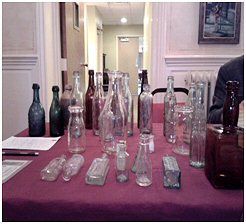
- Beer
Bottles - In the 1870s, beer bottles were made of stoneware.
Mike showed us an example from Philadelphia.
In the 1880s the bottles were typically embossed glass.
Mike also showed us an example of a bottle done not
directly by a beer company, but rather by a contractor to
the beer company. After Prohibition, bottling companies
stopped embossing. On a commercial note, a pivotal point
in bottling occurred with the invention of the Owens Automatic
Bottle Machine, patented in 1903 by Michael J. Owens. This
machine moved the industry away from semi-automatic manufacturing
to manufacturing devoid of human labor. Though some manufacturing
occurred in 1904, it was in 1905 when serious manufacturing
commenced.
- Soda
Bottles - Mike showed us some nice examples, including
an early 1840-1850 bottle from Cleveland. The 1880s produced
some nice colored soda bottles and collectors tend to collect
by color. Mike also had a relatively scarce example from
New Hope, PA and one by Francis Brothers, Doylestown, PA.
The Mercer Bottling Co. embossed an "M" on the
bottom since the bottles went into the case upside down.
Mike also shared a machine-made embossed bottle from New
Hope, PA. In addition to color, collectors of soda bottles
also collect because of the graphics and others by shape,
e.g., bowling pin style. Mike also mentioned that in addition
to collecting the actual soda bottle, collectors also seek
advertising blotters and post cards. Because so many of
the soda companies had not the money to advertise, such
paper is relatively scarce and thus desirable.
- Milk
bottles - Many bottles exist from farm dairies in Pennsylvania
and New Jersey. Mike showed us examples from Doylestown,
PA. and Langhorne, PA., of a larger size. Regarding creamers,
Mike noted that most have painted labels. By the 1950s,
silk screening was used on various dairy bottles, e.g.,
sour cream, cottage cheese bottles, etc.
- Drug
Store Bottles - Because these bottles were often paper-labeled
and non-returnable, they were thrown away. In the day, that
meant they were dropped down the outhouse hole, leading
to an eventual collector "treasure trove." Patent
medicine bottles are very collectible, based on location
and what they contained. Color is also a factor, with cobalt
blue the more desirable. Lydia Pinkham bottles, especially
with contents, are desirable. Mike showed us an early 1830
bottle and a Jersey City Shoe Dye bottle.
- Cleaning
Bottles - Do not remove the labels!! Sometimes patent
bottles still have the contents in them. Remove with ammonia
the contents. A mint bottle will remain! For removing stains
from a bottle, the product "LimeAway" works okay.
Some collectors choose to have the bottles cleaned professionally,
at a cost of $15-$25. Cleaning means removing the mineral
deposit from the surface of the bottle. Mineral deposits
occur when the bottles have been in the ground for long
periods of time. These deposits give the bottle a stained
look, or a cloudy appearance. Most bottle collectors have
an assortment of bottle brushes and are fairly adept at
removing remove the dirt and grime from the bottle.
Mike
mentioned that there are a few bottle shows in the area, e.g.,
four in New Jersey and two in Eastern PA. Regarding the collecting
market, Mike indicated it is fairly stable, with younger folks
entering the market. These folks typically buy bottles from
their community. This fundamentally concluded the formal presentation;
Mike then took questions, from which we learned the following.
Retail prices for beer bottles from the late 1800s are typically
in the $35 range, milk bottles in the $10-$20 range. Age of
a bottle is determined by the neck itself. Approximate age
of earlier graphite bottles can be determined by the bottom
on some. As we move through time, however, age is determined
by the top, rather than from the bottom. Coca-Cola bottles
were heavily reproduced in the 1970s, so be aware of that.
Serious bottle collectors today dig outhouses to seek out
the treasures. A nice discovery occurred in Trenton, N.J.
about two years ago. A collector dug an outhouse, and after
cleaning the bottle, discovered it was a $7,000 bottle!! Outhouse
diggers use a particular probe to detect glass underground.
These folks typically know where the outhouses should have
been relative to the house. Sometimes old land plots include
the outhouse, though we know the holes and outhouses were
moved from time to time. Typically they were located not extremely
far from the house, just far enough. They also were frequently
situated near lilac bushes or alternately, lilac bushes were
often planted near the outhouses.
This concluded Mike's presentation. Thanks to Mike for sharing
a collecting world with which many of us are not familiar.
Mike's enthusiasm and knowledge shined throughout the presentation.
|
|
Antique
Weapons
By Stanley Smullen
Edited by Eleanor Jenitis
|
|
Stanley
Smullen shared with us a history and education of antique
weapons.
Stan shared with us the genesis of his collecting. He originally
started collecting coins at an early age right up until high
school, where he migrated to collecting antique weapons. He
ran into some folks who had weapons and Stan then traded coins
for weapons, a strategy he found beneficial.
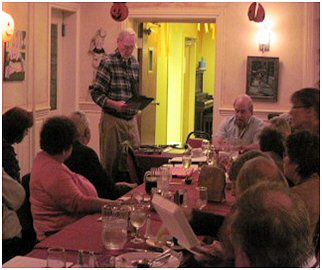 Stan
reminded us that in an evolutionary light, what separates
man from other life forms is the development and use of tools
and weapons. Likely the first weapon man used was a stick
or rock in its raw state, and then perhaps later a rock sharpened
with fire. Then man likely utilized a rock with sling to gain
velocity, and continued to evolve to forge spears, knives,
swords, etc. throughout the eons. Stan
reminded us that in an evolutionary light, what separates
man from other life forms is the development and use of tools
and weapons. Likely the first weapon man used was a stick
or rock in its raw state, and then perhaps later a rock sharpened
with fire. Then man likely utilized a rock with sling to gain
velocity, and continued to evolve to forge spears, knives,
swords, etc. throughout the eons.
Fast
forward to the 19th century, whereby the Chinese are credited
with inventing gunpowder. Probably the first gun was hollowed
out bamboo or iron, loaded from the front, place the ammunition,
then laid the powder on top.
Early
guns were a bit dangerous. A designated shooter would hold
the weapon, another individual would put a flame to the touch-hold.
Look out, at times more dangerous to the shooter than the
intended victim! Eventually, the use of slow matches and flint
became the accepted methodology.
Sometime
during the 1800s, the true flintlock firearm came into being.
Stan showed us a 1780 example. It was English and its loading
method was powder, ball and a rod tamps it down. In response
to a question as to how safe was this methodology, Stan indicated
extremely safe.
Stan described the firing process of flintlock firearms and
the difference between this and earlier matchlock. (A frizzen
is an "L" shaped piece of metal hinged at the rear
used in flintlock firearms. The flint scraping the steel causes
a shower of sparks to be thrown into the flash pan.) The flintlock
gun basically has the priming powder going into the pan, the
piece of flint held in place with set screw, with leather
around it, gun is readied for fire, at full cock, the flint
strikes the frizzen and ignites the powder in the frizzen
pan, then some time delay.
The
next step in the gun evolution process was the percussion
lock. Stan showed us an 1840 dueling pistol as example. The
loading process was the same as the flintlock, but without
the priming pan; instead had a percussion copper cap on top.
The percussion cap is a small cylinder of copper or brass
that was the crucial invention that enabled muzzle-loading
firearms to fire reliably in any weather. The cap has one
closed end. Inside the closed end is a small amount of a shock-sensitive
explosive material. The percussion cap is placed over a hollow
metal "nipple" at the rear end of the gun barrel.
Pulling the trigger releases a hammer which strikes the percussion
cap and ignites the explosive primer. The flame travels through
the hollow nipple to ignite the main powder charge. So fundamentally,
cock and shoot. This is real improvement over the flintlock.
Iconic
in firearms history is the percussion-repeating revolver introduced
by Samuel Colt in 1836. This revolver was a game-changer,
enabling five-six shots and easy to load. The ability to rapidly
shoot five-six shots helped reduce the emphasis of accuracy,
since a missed shot could be rapidly followed by another.
The heart of Colt's invention was a mechanism that combined
a single barrel with a revolving chamber that held five or
six shots. When the weapon was cocked for firing, the chamber
revolved automatically to bring the next shot into line with
the barrel. Stan showed us an 1860 model, .44 caliber. The
Colt was used heavily during the Civil War. The North dominated
the use of this weapon as the South could not get their hands
on enough of them. As Stan indicated, the revolver was remarkable
in engineering, with a barrel wedge on the side, barrel comes
off, cylinder comes out, soldier would have the cylinders
already loaded in his pouch, would simply slip the cylinder
on, replace the barrel, and fire.
Stan
also showed us a Colt Model 1877 "Lightning." This
was a double action revolver manufactured by Colt's Patent
Fire Arms. It was the first successful US made double-action
cartridge revolver. The Model 1877 was offered in three calibers.
The principal difference between the models was the cartridge
in which they were chambered, the "Lightning" being
chambered in .38 Long Colt.
Stan
then moved us through a brief discussion of value, and how
it is determined.
Stan
showed us a silver knife with an American eagle on it, with
scabbard. He told us the story of how last year, an antique
knife was sold as a letter opener for $35. In reality, it
was a naval officer's dirk. A thrusting weapon, the naval
dirk was originally used as a boarding weapon and functional
fighting dagger. It was a personal weapon of officers engaged
in naval hand-to-hand combat. It's worth is actually in the
range of $2,000 - $3,000. So, it pays to know what it is.
Stan
referred us to "Flayderman's Guide to Antique Firearms"
as a sound reference source. Auction catalogs are also helpful,
along with trade magazines in both identifying what it is
and potential value. Stan again emphasized the importance
of knowing what you have. If you buy a gun, buy a book about
the gun. If you sell the gun, keep the book. It is your reference
for future.
Stan
then moved to the usual bane of our profession, fakes/forgeries.
Colt
revolver reproductions were made heavily from the 1960s, as
war reenactments became more popular. Some will show honest
use. Others, though, have had the markings taken off, been
buried, then attempted to be sold as antique.
Stan
indicated the number of fakes is a real threat today. He showed
us examples of silver dollars, German WWII insignia, all fake.
The silver dollars were made in China.
sometimes with making them with 90% silver to help enhance
the fake. Earlier ones, when made of metal, are very easy
to detect. Just put a metal detector to them.
As
with virtually all collecting disciplines, rarity is always
a factor in value, what Stan referred to as the "survival
factor," along with the number made. Value is also driven
by whether it has historic interest, e.g., Civil War association,
Wild West, cowboys, Gold Rush, etc. Stan emphasized, one needs
to do the research.
Stan
wrote an article for the "Civil War Trader." Stan
also referenced a story highlighting the need for doing the
research and knowing what you might have. A sword was purchased
locally which was a Tiffany silver mounted presentation sword
with engraving on the scabbard, Civil War era. This was originally
appraised at approx. $7,000. Purchaser contacted a research
service company, which traced the colonel and regiment, delivering
16 pages of research, which also included a period photo of
the respective Colonel with that sword. There was an association
with an Indian agent for the Navajo Tribe, involved in the
march. Colonel died in 1869 from hostile activity. Ultimately
the sword sold for $12,000. That's what we call "selling
history!"
Stan
briefly discussed condition and its place in value assessment.
There is Basically new; Honest use; Reconditioned; and Poor.
Stan showed us an example of a gun where the serial numbers
on the parts don't match. Value approx. $500-$600. It was
indicated that the U.S. Army used to send guns for refurbishment.
In that process, myriad parts were kept in a bin and utilized
as part of the refurbishment. These guns were issued to Indian
scouts. Stan's example has a mark indicating refurbishment,
and because of that mark, value approx. $1,500.
Dan
Worden mentioned that the refurbishment process is still occurring
with M1s for our Honor Guards.
As
we see in many areas, market value down now, except for the
higher end items. Low end still selling, but middle not so
much. Stan mentioned there is a blue book of gun values for
modern arms, which is helpful.
In
closing, Stan touched upon firearm regulation. Be aware of
all laws! E.g., know that while New York State may have liberal
(liberal meaning favorable to bearing arms) laws, New York
City does not! In New York City, even out of city police officers
must surrender their weapon(s) at the first precinct entered.
Pennsylvania has liberal laws, New Jersey does not and is
horrendous in that regard.
What
about selling a weapon in PA? Antique arms (prior to 1898)
do not require a background check and may be traded without
a license. If purchasing a gun made post 1898, at a gun show
or auction, the vendor, designee or auction house will contact
Harrisburg, PA., for the real-time background check. The serial
number is crucial in dating the weapon. E.g., Colt has a reference
book to match serial number and date of manufacture. Can be
a tad tricky though. E.g., an 1877 model Colt revolver, but
made in 1904, is a modern weapon and needs the background
check performed.
In
closing, Stan showed us a large and heavy piece of original
flint as it comes out of the ground. Thank you, Stan, for
a great history and very illustrative examples of antique
weapons!
|
|
Antique
Anvils
By Ivan Raupp
Edited by Eleanor Jenitis
|
|
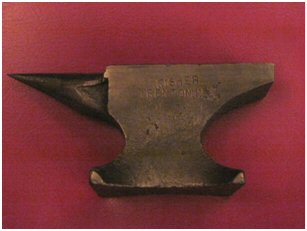 Ivan
Raupp, shared with us his expertise on antique anvils. In
concert with his presentation, Ivan distributed hard copies
of his presentation: "The Anvil: A cool old tool that
gets no respect!" Ivan
Raupp, shared with us his expertise on antique anvils. In
concert with his presentation, Ivan distributed hard copies
of his presentation: "The Anvil: A cool old tool that
gets no respect!"
Ivan
opened with his comment that he is delighted to be a member
of the BCADA and looks forward to the many meetings and events.
Ivan is an anthropologist by education; journalist in all
other respects. Blacksmithing is something which has always
intrigued him. He collected iron for many years and is a self-taught
blacksmith, preferring to use old tools. He reads a lot on
the subject and consults with those in the industry.
Ivan
spoke of the technology around the iron and how it connected
to the mines, railroads, and local geographic areas, e.g.,
Allentown/Bethlehem area (e.g., anthracite).
He
then noted: The art and science of blacksmithing - to have
a creative vision is a kind of prerequisite to making something
beautiful. And it is the anvil which helps make it happen!
Anvil
Shape:
A natural evolution - particular to the blacksmith.
Form
follows function; presents harmony & beauty; moving from
random design to purpose functional design; every element
of the anvil's design has a function.
Ivan also noted two famous industrial designers, Raymond Loewy
and Henry Dreyfuss.
Parts
of the Anvil:
Horn; table; face; hardie hole; pritchel hole (which came
along in the late 1700s); heel; body waist; base; foot; shoulder.
Can
heat to 1500 degrees the horn. The table is softer metal and
is where the blacksmith cuts. He raises the heat so that he
can cut. The face is a hardened piece of steel.
Oldest
version of an anvil is found in St. Augustine, Florida.
Determining anvil weight:
Usually stamped into the broad right side (with the horn pointing
to the right); American anvils stamped in pounds; English
anvils use the ancient "stone" system to show weight
and will show three numbers - the leftmost number indicates
hundred weight = 112 lbs.; the middle number indicated quarter
hundred weight = 28 lbs.; the third number indicates the remaining
pounds less than a quarter hundred weight.
So, an English anvil stamped "2-2-20" would be calculated
as follows:
(2x112) = 224 lbs. + (2x28) = 56 lbs. + 20 lbs. = 300 lbs.
Thus a "2-2-20" = 300 lbs. (a very big anvil).
Dates
for anvils:
1500-1780 - Colonial anvil and Colonial anvil with horn
1780-1830 - Colonial and old English
1830-1850 - Old English; looks more graceful vs. cobbled together
1850-1895 - Peter Wright perfected a 2 pc process for making
1895-1950 - Modern
1950-present - Cast steel
The
shape of the anvil helps the blacksmith move hot metal. The
most commonly used techniques are:
Drawing out (making a thick piece thinner, e.g., as in making
a nail;
Upsetting, the opposite of drawing out, e.g., as in "heading"
a nail;
Bending, as in shaping a hook;
Twisting, as in applying decoration to wrought iron railings;
Hot cutting, using a chisel to sever a piece of hot metal;
Forge welding, fusing pieces of hot metal together;
Punching, using the pritchel hole to create an opening in
the red hot metal, to create an "eye" or an opening
to be threaded;
Riveting.
Ivan
shared a bit of cast iron anvil commercial history. Two men,
Fisher & Morris, started out in Maine, in a barn. C. 1840
the barn burned down. They see a piece of steel forged onto
a piece of wrought iron, due to the extreme heat of the burn..
They simulated the circumstances, started the process and
a business! It is often called a dead anvil because there
is no ring when it is hit.
Ivan
also gave us a "roadmap" to help identify anvils.
A good reference guide is by one Richard Postman. And of course,
on-line sources are plentiful.
On
a concluding commercial note, Ivan indicated that anvil miniatures,
those tiny anvils which were salesman's samples or promotional
pieces, are highly prized collectibles.
About
pricing, Ivan gave a rule of thumb $2/lb., though with a rare
anvil sky is the limit. Ivan purchased a salesman's sample
@ $75 and thought that was a very fair deal.
To
best determine the age, Ivan showed the chart on shapes and
era. He also mentioned that during the Civil War, soldiers
broke off the table of the anvil to try and render it less
effective.
|
|
Antique
Metal Toys
By Jim Wiley
Edited by Karen D'Anjolell
|
|
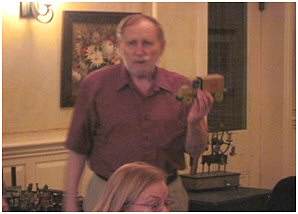 Jim
informed us that tin toys are currently very active at auctions
including Noel Barrett auctions at the Eagle Fire hall in
New Hope. Tin toys were at their most popular from the mid-19th
century to the early 20th century. Jim
informed us that tin toys are currently very active at auctions
including Noel Barrett auctions at the Eagle Fire hall in
New Hope. Tin toys were at their most popular from the mid-19th
century to the early 20th century.
'Mechanism'
types are better quality than 'cast iron' type toys but are
going down in value. Meanwhile the 'cast iron' toys are growing
in value.
One
of the earliest companies was Pratt & Letchworth from
Buffalo, NY who made iron and steel toy carriages. This may
be because they started out making saddlery hardware in the
1860's. There are no marks on these toys and you need to have
a reference book to determine the manufacturer.
Strauss,
another manufacturer of primarily tin cars and trains, started
in East Rutherford, NJ. They hired Louis Marx who later started
the Marx Toy company.
Many
of the tin trains made in the 1850's to 1860's were from Philadelphia
including Francis Field, also known as the Philadelphia Tin
Toy Manufacturing company. Many tin toys in the 1800's came
from Germany as well including Bing in 1863, Fleischman in
1887, Lehman in 1881, and Guntherman in 1870. They set the
high standards for the German tinplate industry.
A
company from Dayton, Ohio called Dayton Clarke made inertia
wheeled toys like a 7" tall and 7" long cast iron
tin car that is worth $500.
Gibbs
Toy Company from Canton, Ohio, started out making doll houses
in 1910. Jim had an example of a Gibbs see-saw toy that was
worth $100.
A
wind-up truck on track by the Wolverine Company of Pittsburgh,
PA was made in the 1920's and worth about $75.
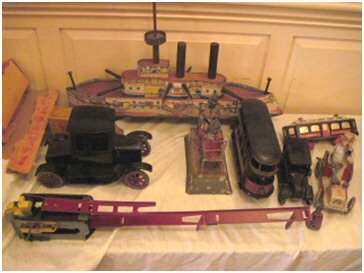 Jim
brought an impressive large lithographed stamped metal ship
in the Spanish-American War style by the Converse Toy Company
from Massachusetts. It was about 22" long and worth $2,000. Jim
brought an impressive large lithographed stamped metal ship
in the Spanish-American War style by the Converse Toy Company
from Massachusetts. It was about 22" long and worth $2,000.
Other
examples of tin toys from Jim were the German made nice sounding
'Black Minstrel' toy and the 'double decker trolley' car.
Both by the Guntherman toy company from the 1870's. Both were
worth about $70 each. It was noted that real double decker
trolleys are still used in Hong Kong and other parts of Asia.
Another
German company called Lehman tried to make toys of 'everyday
life'. Jim's example was a 6" tall piano player whose
clothing was made in France but painted in Germany. This was
worth $200.
Many
of these early metal toys have no marks and you need to reference
books to determine the manufacturer and the value. When you
find early small tin toys in all original paint and in working
condition, they are still only worth in the $30 to $70 range.
You can find them in toy auctions everywhere. One member said
it seems a shame that they aren't worth more but they are
what the market says they are.
Jim
exhibits and gives seminars every other Saturday at the Mercer
Museum in Doylestown. This is free with the general price
of admission to the museum.
|
|
Precious
Metals
By Kim Hemingway
Edited by Eleanor Jenitis
|
|
Kim
is a member of the PA Auctioneer's Association, holding myriad
positions within the Association. Kim, an auctioneer for 21
years, is a gemologist, specializing in jewelry. She also
offers appraisal services.
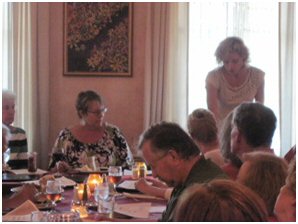 Kim
delivered a very informative presentation on "Metals,
with an Accent on Jewelry." She commenced the presentation
by passing around multiple trays of jewelry to help illustrate
the markings found on jewelry/metals. Her presentation walked
us through the various metals and how to identify jewelry
and its metal content. Kim
delivered a very informative presentation on "Metals,
with an Accent on Jewelry." She commenced the presentation
by passing around multiple trays of jewelry to help illustrate
the markings found on jewelry/metals. Her presentation walked
us through the various metals and how to identify jewelry
and its metal content.
The
karat (k) designation in gold is an indication of the amount
of pure gold/alloy which is present in the jewelry. 24k is
pure gold; as the numeric k declines, so does the amount of
gold. For example, 18k = 75.00% gold, 14k = 58.33%, 10k =
41.6%.
While
24k is pure gold, it is thus "softer" and very malleable.
So from a jewelry manufacturing perspective, jewelry that
is subject to friction or impact is typically made of a lower
karat gold. E.g., men's jewelry or rings tend to typically
be 14 or 10k, as are many bracelets. It is simply a matter
of practicality to have the lower karat gold.
Kim spoke of the various markings / hallmarks found on jewelry.
She told us to always look closely and to use a loop to help
identify the karat and/or assay mark. (The assay mark indicates
the maker and/or origin of the piece.) For example, with gold,
an eagle's head (a French mark) indicates 18k.
With
platinum, "950" indicates 10% Iridium, 900 ppt Platinum.
French Dog's Head points to manufacture after 1912.
There
are a lot of gold hallmarks, so it is important to do the
research to fully identify the piece of jewelry. Another example,
if one sees "585," it means 585 parts of 1,000.
The rest of the jewelry content would be alloys, added to
give color/strength. E.g., adding copper will give the gold
a rose color.
Kim
mentioned that while solid gold is technically 24k with no
other elements or alloys, the Federal Trade Commission (FTC),
in June 1963, said that items can be called solid gold if:
it does not have a hollow center; and, it has a fineness of
10k or more. Interesting.
Jewelry
is measured (weighed) in pennyweight (DWT = denarius + weight).
This designation originated because the Scottish believed
that their penny weighed the same as the Latin Denarius.
Kim
touched upon "Heft & Appearance" to also help
with identification of jewelry. With respect to weight (heft),
platinum is the heaviest, followed by gold, silver and base
white metals and brass. One can definitely tell the difference
in platinum weight.
With
respect to appearance, tarnish is an indicator of the metal.
High karat white gold alloy, rhodium, palladium and platinum
do not tarnish. Rhodium and palladium are in the platinum
family and are often used as a plating. It will have the look
of platinum, but is less expensive. The more alloy, the more
tarnish. Common alloys include silver, copper, nickel, iron,
tin, manganese and zinc.
Kim
then walked us through the various metals and some highlights
regarding them.
White
gold: developed in the 1880s; contains no silver; contains
10 - 20% nickel + zinc, copper and sometimes platinum or manganese.
Gold
Platings: gold-filled = 5% of total weight in karat gold;
rolled gold plate = 1/40 of total weight in gold; gold electroplate
= made by using electrolysis, least valuable (HGE" -
heavy gold electroplate). If you see a fraction marked on
a piece of jewelry you are certainly looking at a piece of
gold filled jewelry. Have a look at the edges of the jewelry
where it is most likely to be worn out or rubbed. That is
typically where you'll see the general loss and can see the
base metal eventually, e.g., brass.
Platinum:
the choice metal; more costly & rare than gold; whiter
than gold; strong, does not oxidize and is hypo-allergenic.
Platinum began to be used in jewelry in the mid-1800s; in
1973 the Hallmarking Act was initiated which indicated no
jewelry is to be marked platinum if it falls below 950/1000.
Sterling
Silver: FTC states that anything less than 925 silver cannot
be called "sterling;" it is 92.5% silver, 7.5% alloy
(commonly copper); it was widely used for costume jewelry
during WWI because many other metals were being used for the
war effort.
The
French Boar's Head & Crab indicate 800 silver or higher.
Boar's head was used 1838-1961 in Paris Assay office; Crab
used 1838-1961 outside Paris; since 1962 was also used in
Paris.
Kim
mentioned that Mexican Silver had tended to be of a higher
silver content and well made: 95% silver, 5% copper ("950"
or "Mexican Silver").
Pocket
watch case markings: sometimes marked on inside of case; "Guaranteed"
= gold filled; "Warranted" = gold filled OR gold;
silveroid, silverode, silverine, silverore = 45% nickel, 54%
copper, 1% manganese.
Kim
concluded her prepared remarks indicating that for all the
hallmarks and markings out there, much jewelry is not marked
at all, particularly earlier jewelry. Thus, one needs to sometimes
test the metal, notice the way stones are set, the actual
setting, etc., in order to identify of what metal the jewelry
is comprised.
Kim
then took questions. Following is a brief summary of the responses.
Native
American jewelry often has higher silver content than most
jewelry.
Kim still does acid testing, hasn't migrated to the higher
technology just yet.
Gold-filled = gold plate.
Re: cleaning jewelry... first determine the fineness. Best
to use lukewarm water, toothbrush, soft soap liquid. For diamonds,
one can use rubbing alcohol, but only with a diamond!
Jewelry appraisals: Kim determines the purpose of the appraisal,
e.g., insurance, determines current market for the item, its
mineral content and market value. She charges by the hour,
goes to the customer and is bonded.
Kim
may be reached at 215-541-4025 and is located in Perkiomenville,
PA.
|
|
Restoring
Glass
By Charles Sorrels
Edited by Eleanor Jenitis
|
|
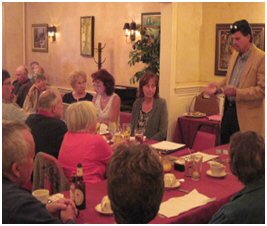 Charles
is a master glass maker with 25 years' experience and also
does restoration work. He has a master's degree from Rochester
Institute of Technology School of American Craftsmen and has
his own art glass studio. Several of our members have engaged
Charles' services for repair to their antique glass pieces. Charles
is a master glass maker with 25 years' experience and also
does restoration work. He has a master's degree from Rochester
Institute of Technology School of American Craftsmen and has
his own art glass studio. Several of our members have engaged
Charles' services for repair to their antique glass pieces.
This
presentation had a different spin to it with its focus being
on the repair aspect of glass and the corresponding challenges
based upon the quality, age and type of glass to be repaired.
Charles
indicated the equipment and tools of the trade are similar
to those used in the lapidary (gem cutters) industry. Charles
then shared the myriad highlights, salient points and challenges
in his business, in the order presented, as follows:
- basic
chips & rims can be taken out rather simply; he can
take out the entire rim, going beyond the rim itself, but
making sure the manufacturer's rim remains intact; he likes
to round the edges slightly, reducing the possibility of
chipping;
- Feathering
is a technique used if one wants to avoid going into the
pattern on the rim; just enough of the damage is removed
without creating too much of a dip;
- removing
bruises can be tricky, e.g., if there is an impact point
on the side of a piece, how deep is the bruise actually?
Some material can be removed, but sometimes he finds that
the impact is deeper than originally know and reduces the
ability to fully repair;
- the
glues he uses are all archival, won't yellow; only extreme
heat would cause "bleeding;"
- tumbling
is a technique to remove mineral deposits whereby the actual
glass starts deteriorating (devitrifying); Charles has designed
his own tumbler, an oversized 30 rpm (slower than commonly
used) device, with a mix of cut copper wire and polishing
compound, which provides weight and drag on the interior
surface and slowly facilitates the removal of material;
this has been quite the innovation;
- with
Northern European glass, sometimes you will see gather lines,
e.g., sleeving layers of glass; they look like small cracks,
and yes, it will get worse over time;
- cords
are weird striations caused by glass stones on the bottom
of the furnace (and are actually chunks of the furnace);
they become embedded in the glass during manufacture; if
you notice one in your glass piece, just leave it; don't
try and remove;
- exterior
scratches on glass can be addressed; when on the interior,
they become trickier to remove, as it is difficult to get
a tool to it; those scratches can be a problem;
- cracks
can be addressed, an archival glue can be applied;
- Bill
D'Anjolell asked if a piece has too many cracks, is it not
fixable? Charles indicated maybe, probably; but if the piece
is extremely rare or carries high sentimental value, Charles
can always have a go at it;
- stained
glass can be repaired, along with the lead; challenge there
can be matching the color;
- glues
play a large part in the repair business, from re-assembly
to re-construction; a piece can always be reconstructed,
it's just a matter of whether it will be visible or not;
- with
acid etching or sand blasting repair, a sugar acid can be
used to try and match old sand blasting patterns; Charles
mentioned an example of having a decanter with a broken
neck; he was able to find another neck, glued the two and
matched the pattern;
- a
question was raised regarding the cost of repairs; a chip
in a rim can be $8-12; replacing or repairing a slag glass
panel could be $140; price varies considerably based upon
the challenge and complexity of the repair;
- a
question was also raised regarding older glass, e.g., an
early Steuben; can the color be matched? yes, but is more
complex because of the chemicals used to make the colors
then; one repair he did ran $400;
- a
question was asked whether newer glass vs. older glass can
be determined? yes, older glass usually just feels a little
different, e.g., texture and feels more oily; but, as a
member pointed out, it can depend upon the maker, e.g.,
Bohemian glass vs. a Baccarat or a Steuben, whose factories
would destroy anything less than perfect;
- iridescent
glass is quite difficult to replicate due to the stannous
chloride fuming used;
- a
concluding question was would Charles appraise an item first
to determine whether it is worth repairing? Yes.
Upon
the conclusion, Ashley King mentioned that Charles had done
a repair for him and endorsed the work, saying he was extremely
fair. Mike and Judy Young, and Sara Abir indicated he's very
reliable, and prompt.
Charles
Sorrels may be reached by email:studio@sorrelsglass.com, or
at 267-261-6289 or 610-965-1732.
|
|
History
of Lithography
By Doreen Dansky
Edited by Karen D'Anjolell
|
|
Member speaker, Doreen Dansky discussed the history of lithography
and printing with examples from her personal collection.
Lithography
was invented by German actor/play write Alois Senefelder in
1798.
In
original lithography work, dots are random. In reprints dots
are in a pattern.
 Beginning
in 1837 McKinney and Hall sold subscriptions to 'History of
Indian Tribes in North America", which were books of
commissioned Indian portraits. McKenny worked for the Office
of Indian Affairs. Hall wrote biographies. It actually ended
up costing them more than they charged for the books. Subscriptions
costs $120, which for the time was very expensive. Today they
range from $400-$2,000, with the more elaborate dress being
more valuable. Beginning
in 1837 McKinney and Hall sold subscriptions to 'History of
Indian Tribes in North America", which were books of
commissioned Indian portraits. McKenny worked for the Office
of Indian Affairs. Hall wrote biographies. It actually ended
up costing them more than they charged for the books. Subscriptions
costs $120, which for the time was very expensive. Today they
range from $400-$2,000, with the more elaborate dress being
more valuable.
In
1835 Nathaniel Currier published his first successful disaster
print, Ruins of the Planters' Hotel, New Orleans. He went
on to become most successful lithographer. In 1857 he and
his bookkeeper, Ives, became partners. Together they produced
more than 7,500 titles. Their work was varied and covered
all topics. Subject matter and size can add more value. Unusual
ones can bring as much as $10,000. Prints originally sold
for between 5 cents and $3. They described themselves as "publishers
of cheap and popular prints". Their partnership dissolved
in 1907. Most of their stones used to create prints were destroyed.
They rarely show up at auctions today.
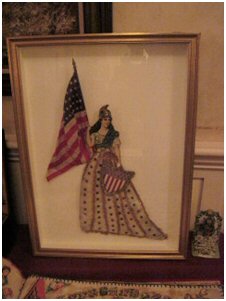 Every
color has its own stone in Chromolithography. Louis Prang
of Boston was the most famous American chromolithographer.
He started his business in 1860 and was known as the father
of the American Christmas cards. Every
color has its own stone in Chromolithography. Louis Prang
of Boston was the most famous American chromolithographer.
He started his business in 1860 and was known as the father
of the American Christmas cards.
The
Germans were the masters of chromolithography and that is
where people went to study it. It was also used as an art
form by famous artists such as Toulouse Lautrec.
Almost
anything can be lithographed…books, greeting cards, postcards,
tin toys, wooden toys, boxes, art, porcelain, fabric, posters
and more. Decker and Wyeth posters bring more money than others.
Doreen
had many items from her personal collection to share with
us that included artwork, posters, fabric book, greetings
cards, fans, books and more. Within Doreen's collection were
7 small chromolithographed rocking horses valued at $150.
A large framed lithographed woman with a small American flag
was valued at $300.
At
the end of the meeting, members viewed some of her favorite
pieces from her collection displayed on several tables before
they left the meeting. It was a very nice presentation.
|
|
The
Story of the True Inventor of the Steamboat
By Eric Fleischer
Edited by Eleanor
Jenitis
|
|
Member
Speaker, Erik Fleischer, presented "The Story of the
True Inventor of the Steamboat." The presentation was
very good and provided a wonderful insight into a fascinating
Bucks County historical commemoration and contribution to
this great Country.
Erik introduced us to the John Fitch Steamboat Museum, of
which Erik is a member. The museum is located in Warminster,
PA. Members are strongly encouraged to explore the museum,
either in person and/or at www.craven-hall.org
or on YouTube (John Fitch Steamboat Museum).
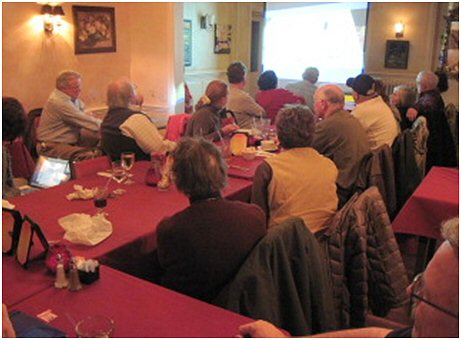 Erik
shared some images from the Grand Opening of the converted
museum, which included ribbon-cutting ceremony and assorted
dignitaries in attendance. Erik
shared some images from the Grand Opening of the converted
museum, which included ribbon-cutting ceremony and assorted
dignitaries in attendance.
John Fitch introduced the steamboat concept 17 years prior
to Fulton, yet Fitch remained in relative obscurity. Myriad
events drove Robert Fulton to ultimately be remembered more
as the inventor of the steamboat.
That said, several memorials can be found for Fitch, including
a fresco in the United States Capitol by Contantino Brumidi,
depicting Fitch working on one
of his steamboat models. Various other statues/commemoratives
can be found scattered around the country, including PA.,
Connecticut, Kentucky and New Jersey.
Fitch's trade was clockmaker and settled in Trenton, NJ in
1769. Then he went on to become a silversmith. During the
Revolutionary War, he had to flee and lost his business. (Silver
spoons are known to exist with his mark on them, so be alert!)
Fitch joined the N.J. Militia. One anecdotal story has it
that at the time, one could not fit a bayonet on a farmer's
musket... So Fitch "invented" fitting a bayonet
on a farmer's musket..."
His life's journey evolved and he became a land surveyor.
But his attention became riveted on wondering why transportation
vehicles could not be powered by steam. He built models and
petitioned for funding for his projects, but was met with
mediocre success on the financial front. He even looked to
our Founding Fathers for assistance. He finally secured some
money by selling shares of his invention so he could build.
But meanwhile, and in the end, patents were ultimately issued
to several people for the invention.
Again, members are encouraged to look up this fascinating
chapter in American Industrial history. And of course, your
most immediate source is Erik Fleischer himself!
|
|
Where
do names come from?
"Credenza"
By Arthur Schwerdt
of August Farmhouse Antiques, Cape May, NJ
Edited by Bill D'Anjolell
|
|
 The
Credenza is a funny sounding name for a piece of furniture.
A Credenza is a side cabinet that is more compact than a sideboard,
and low to the ground usually without legs. There may be doors
or drawers or open shelves on the side. They could be veneered,
inlaid, painted with scenes, or decorated with ormolu (gilt
metal). When someone was promoted in their company into a
larger office, employees might say, "Congratulations
and the office has a credenza!" It sort of meant you
were moving up in the company. The
Credenza is a funny sounding name for a piece of furniture.
A Credenza is a side cabinet that is more compact than a sideboard,
and low to the ground usually without legs. There may be doors
or drawers or open shelves on the side. They could be veneered,
inlaid, painted with scenes, or decorated with ormolu (gilt
metal). When someone was promoted in their company into a
larger office, employees might say, "Congratulations
and the office has a credenza!" It sort of meant you
were moving up in the company.
 The
word 'credenza' translates from the Italian word 'trust'.
During the Renaissance period (about the 14th to the 16th
century), the Kings, the Nobles, and the wealthy placed their
food and wine in the dining hall on the credenza to be tested
by servants for poison. Then they and their guests would feel
free from assassination. The
word 'credenza' translates from the Italian word 'trust'.
During the Renaissance period (about the 14th to the 16th
century), the Kings, the Nobles, and the wealthy placed their
food and wine in the dining hall on the credenza to be tested
by servants for poison. Then they and their guests would feel
free from assassination.
The
Credenza made a popular return during the Renaissance Revival
of the late Victorian/Edwardian period (1880 to 1910). Today,
they are not restricted to the dining room but can be used
anywhere especially in one's office, or as a hideaway bar.
"Name your poison!"
|
SWORDS
BY
F.W. WIDMANN, W.H. HORSTMANN
and the United
States Marines
by Stanley B. Smullen | 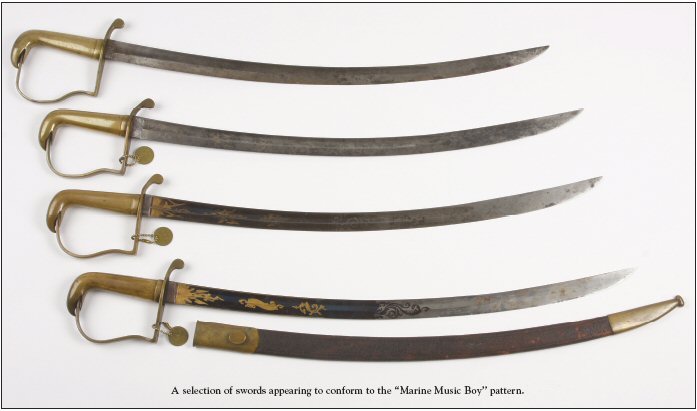
FOR
YEARS, the distinctive swords covered in this article have variously been identified
as “infantry hangers,” “mounted or foot artillery swords”
and “non-commissioned officers swords.” These non-specific labels have
resulted in confusion about their true identification and dating. This article
will demonstrate that these swords have an association with the United States
Marines and will illustrate and describe the known types.
The reason why
we can now tie these swords to the Marines is because of a stroke of good luck.
A number of years ago, noted antique arms author Norman Flayderman acquired some
papers and work drawings of the Horstmann Company of Philadelphia — one of
the foremost makers of American swords during the 19th century. These papers included
drawings
of enlistedmen’s swords, dated Sept. 1851, which show sword types
labeled “Marine Musician,” “Marine Music Boy” and “Marine
Sergeant Sword.” What makes this especially exciting is that groups of swords
survive today that conform quite closely to the types illustrated in those drawings.
A
fourth drawing, also dated 1851 and labeled “Marine Officer,” was also
included. And sure enough, the “Marine Officer” sword illustrated in
this drawing is quite similar to the pattern presently in use by the Marine Corps.
It is not known what motivated the production of these drawings, who did them
or why they are identified as “Marine.” Many of the swords that we have
found conforming to these patterns were clearly made well before 1851. So we have
a bit of an enigma on our hands. But regardless of whatever questions we may have
about the original intent of the drawings, they clearly indicate the actual use
(or, at the very least, the consideration) of these patterns by the United States
Marines. Perhaps the drawings are illustrating a pattern that had already been
in use by the Marines for quite some time...or maybe the Marines were thinking
about standardizing upon a well-established pattern of sword with a long service
history...we just don’t know. Without swords of these patterns having firm
Marine provenance, there is a limit to how much we can hope to learn.
There
are, however, some tempting hints. In McClellan’s Uniforms of the American
Marines 1775–1929 (p. 62), Sergeants and Music’s swords are discussed
but not described...(MORE...see below)
(Click
Here for first part of article with photos...Click
Here for continuation of article with more photos) |
|
|